Dental Office Cleaning Services in Miami-Dade & Broward
The short answer. Dental office cleaning is priced and scoped on operatory count and patient volume, not floor area, and industry rate guides put medical and healthcare facilities at $0.14 to $0.29 per square foot per month (ISSA) — the highest band of any commercial property type, because infection control is labour, not chemicals. The standard is set by the CDC: clinical-contact surfaces barrier-protected or cleaned and disinfected between patients, housekeeping surfaces cleaned routinely. A dental practice needs a dental office cleaning service that can produce the log, not just the result.
Dental office cleaning is the compliance-grade cleaning and disinfection of a dental practice — operatories, sterilization areas, waiting rooms, restrooms, and every clinical-contact surface between them — held to CDC dental infection-control guidance and OSHA standards, not general office habits. It matters more than the square footage suggests: when a high-speed handpiece runs, the contamination doesn't stay at the chair. A Journal of the American Dental Association study tracked spatter and aerosol up to 360 cm — nearly 12 feet — from the patient's mouth during air-turbine procedures (JADA, 2020). Purity Med cleans dental offices across Miami-Dade and Broward the way that reality demands — documented, disinfected between patients, and consistent.
As a family-owned, woman-owned company serving Miami-Dade and Broward, we bring dental office cleaning services to general dentists, orthodontists, oral surgeons, periodontists, and pediatric practices — with BBP-trained crews, EPA-registered disinfectants, and the paperwork that makes inspection day a filing exercise.
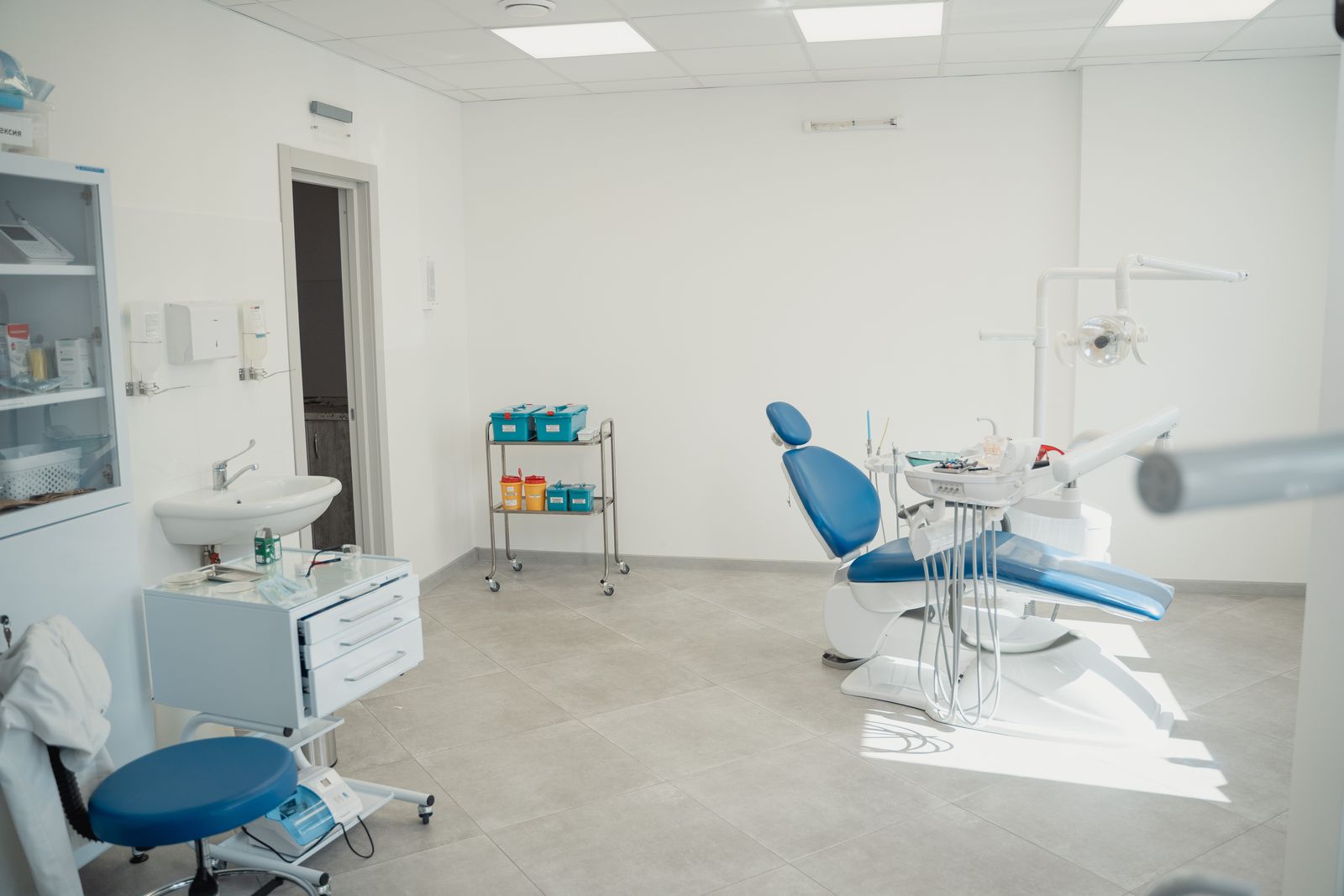
What does dental office cleaning include?
Cleaning dental offices means covering the clinical and patient-facing areas as one documented program — a dental office cleaning service is not an office contract with gloves on. Each piece is its own specialty; tap through for the detail.
Chair, light handles, switches, and tray surfaces cleaned and disinfected between patients, in a documented order.
Details Between-patient high-touch disinfectionThe handles, tablets, and controls staff touch all day, disinfected at full label dwell times.
Details Sterilization & lab-area housekeepingEnvironmental surfaces around the sterilization center kept clean — we clean around your instruments, never reprocess them.
Details Waiting room & receptionThe room patients judge you by, cleaned to clinical standard nightly.
Details Dental restroom sanitationClinical-grade restroom disinfection with full restocking, every visit.
Details Electrostatic disinfectionCharged-mist disinfection that wraps every operatory surface — scheduled or on demand.
DetailsWhat do the CDC and OSHA actually require?
CDC dental infection-control guidance splits your environmental surfaces into two groups, and they're cleaned differently. Clinical-contact surfaces — light handles, switches, chairside tablets, tray tables — must be barrier-protected or cleaned and then disinfected with an EPA-registered hospital disinfectant between patients. Housekeeping surfaces — floors, walls, sinks — carry limited transmission risk and are cleaned routinely (CDC). Layer on OSHA's Bloodborne Pathogens Standard (29 CFR 1910.1030) — a written schedule and BBP training — and you have the framework Purity Med is built around.
"No surface of the operative environment was free from the tracer after the use of the air turbine."
Ionescu et al., Journal of the American Dental Association, 2020"Clean and disinfect clinical contact surfaces that are not barrier-protected with an EPA-registered hospital disinfectant after each patient."
CDC — Dental Infection Prevention and Control: Sterilization and DisinfectionThe CDC draws the other half of the line just as plainly: "Housekeeping surfaces, (e.g., floors, walls, sinks) carry less risk of disease transmission than clinical contact surfaces and can be cleaned with soap and water or cleaned and disinfected if visibly contaminated with blood." Two surface classes, two methods, one written schedule that says which is which in your practice.
That's the whole case for between-patient discipline in one finding: in a working operatory, contamination is a room-wide event, not a chairside one. It's why we disinfect clinical-contact surfaces at full dwell time between patients, train crews on bloodborne pathogens, and match products to each surface — not because it looks thorough, but because the room demands it.
What are you actually buying from a dental office cleaning company?
When an inspector or dental-board surveyor visits, they don't white-glove your ledges — they ask two questions: "Show me your cleaning schedule," and "Show me it happened." A practice with a signed checklist for every visit is in far better shape than one cleaned more often with no records. Purity Med gives you written protocols per area, per-visit checklists, and cleaning logs you can hand over on request — the OSHA/CDC-aligned protocols that turn inspection day into paperwork instead of panic. (For the compliance detail, see our guide on what OSHA requires for dental office cleaning; for what a program covers and what it costs, see the dental office cleaning buyer’s guide.)
How much does a dental office cleaning service cost in Miami?
On operatory count and patient volume, not on square footage. Industry rate guides put medical and healthcare facilities at $0.14 to $0.29 per square foot per month (ISSA) against $0.09 to $0.17 for general office — roughly double, and the gap is labour rather than product. A four-operatory practice seeing forty patients a day is a heavier job than a six-operatory practice seeing twenty, even though the second one has more floor.
Four things move the number more than area does: operatory count, because each one is its own between-patient cycle; patient volume, because that is how many cycles there are; sterilization and lab footprint, which carries the strictest housekeeping; and documentation depth, because a signed per-visit log costs time to produce. We quote after a free walkthrough, in writing, usually within 24 hours, with the clinical and non-clinical areas costed separately so you can see what compliance actually carries. For the long version, see our dental office cleaning buyer's guide and the Miami-specific commercial cleaning cost breakdown.
What should you ask a dental office cleaning company before hiring?
Most dental office cleaning companies in South Florida are general janitorial firms that added "medical" to a brochure. Five questions separate them quickly.
One: are your cleaners BBP-trained, and can you show me the records? OSHA's Bloodborne Pathogens Standard requires it for anyone with occupational exposure, and a practice that hires an untrained crew has inherited the problem. Two: what is your dwell time? If the answer is not "whatever the product label says," the disinfection is decorative. Three: who touches the sterilization area? The right answer is that dental office cleaners clean the environmental surfaces around it and never reprocess or handle instruments. Four: what do I get in writing? Per-area protocols, a per-visit checklist, and a log you can hand to a surveyor. Five: is it the same crew every visit? A rotating pool cannot learn your do-not-touch list.
Purity Med answers all five the same way every time, because dental office janitorial services are a clinical discipline with a mop in it — not the other way round. Our crews are W2 employees, background-checked, trained before they badge in.
Do you clean dental office carpet and waiting-room upholstery?
Yes, and it belongs on the schedule rather than on a phone call. Dental office carpet cleaning is the piece most practices defer longest and notice hardest: a waiting-room carpet absorbs everything a full appointment book walks in, and unlike a hard floor it does not look dirty until it is well past it. We run hot-water extraction on a quarterly to semi-annual rotation depending on traffic, with spot response between, plus upholstery on the seating a hundred people a week sit in.
Operatory flooring is a different question with a different answer. Clinical areas should be hard, non-porous and seamless where possible — carpet in an operatory is not a cleaning problem, it is a design problem, and no cleaning programme fixes it. Where a practice has inherited one, we will say so at the walkthrough. Detail on method lives on our commercial carpet cleaning page, and the hard-floor side runs through floor care.
How often should a dental office be cleaned?
On two rhythms: clinical-contact surfaces between every patient, and the full facility on a documented daily program. Here's the framework we build dental cleaning plans around, then tailor to your operatory count and patient volume at the walkthrough.
| Area | Frequency | What that means |
|---|---|---|
| Clinical-contact surfaces | Between every patient | Barrier-changed or cleaned then disinfected with an EPA-registered hospital disinfectant. |
| Operatory floors & housekeeping | Daily | Full documented clean nightly; disinfected immediately if visibly contaminated. |
| Sterilization & lab area | Daily + after spills | Environmental surfaces cleaned; instruments stay with your clinical team. |
| High-touch surfaces | Every visit | EPA-registered products applied at full label dwell time. |
| Restrooms | Every operating day | Clinical-grade sanitation and full restocking. |
| Waiting & reception | Every operating day | Seating, glass, and floors to clinical standard. |
| Full disinfection reset | Quarterly or event-driven | Electrostatic or full-space disinfection after illness events. |
Where do you clean dental offices in Miami?
We clean dental offices throughout South Florida — the practices lining the professional plazas of Coral Gables, the Baptist corridor in Kendall, the dental groups across Doral and Miami, and up into Broward. If you searched "dental office cleaning near me" from a South Florida practice, you're in our territory. Not a dental office? See our full medical office cleaning program.
What practice managers ask us.
How often should a dental office be cleaned?
On two rhythms. Clinical-contact surfaces in the operatory — chair, light handles, switches, tray tables — are barrier-changed or cleaned and disinfected between every patient. The full facility (floors, restrooms, waiting room, sterilization area) is cleaned to a documented standard daily, with fabric and full disinfection resets on a quarterly or event-driven schedule. CDC guidance drives the between-patient rhythm; Purity Med builds the daily program around it.
What are the CDC and OSHA requirements for cleaning a dental office?
CDC dental infection-control guidance splits environmental surfaces into two groups: clinical-contact surfaces (touched during care) must be barrier-protected or cleaned and disinfected with an EPA-registered hospital disinfectant between patients, while housekeeping surfaces (floors, walls, sinks) are cleaned routinely. OSHA's Bloodborne Pathogens Standard (29 CFR 1910.1030) layers on a written cleaning-and-decontamination schedule and bloodborne pathogen training for anyone with occupational exposure. Purity Med is built around both.
Do you sterilize instruments or clean the sterilization area?
We clean the sterilization area's environmental surfaces — counters, floors, and housekeeping surfaces around it — but we never reprocess or handle instruments. Instrument sterilization stays entirely with your clinical team under your CDC reprocessing protocol. Our crews work to a documented do-not-touch list so that line is never crossed.
How much does dental office cleaning cost?
By scope, not square footage alone — the number of operatories, your patient volume, and your compliance needs all move the figure. As a frame, industry rate guides put medical and healthcare facilities at $0.14 to $0.29 per square foot per month against $0.09 to $0.17 for general office space (ISSA), and the difference is labour rather than product. We set a transparent, written quote after a free on-site walkthrough, usually within 24 hours, with clinical and non-clinical areas costed separately.
What should I ask a dental office cleaning company before hiring one?
Five questions. Are your cleaners BBP-trained and can you show the records? What dwell time do you hold disinfectants to — the only right answer is whatever the product label says. Who touches the sterilization area? What do I get in writing? And is it the same crew every visit? Most dental office cleaning companies in South Florida are general janitorial firms that added the word medical to a brochure, and those five questions separate them from a clinical programme very quickly.
Do you clean dental office carpet and waiting-room upholstery?
Yes, on a scheduled rotation rather than on request. Waiting-room carpet absorbs everything a full appointment book walks in and does not look dirty until it is well past it, so we run hot-water extraction quarterly to semi-annually depending on traffic, with spot response between, plus upholstery on the seating. Operatory flooring is a separate matter: clinical areas should be hard, non-porous and seamless, and carpet in an operatory is a design problem no cleaning programme can fix.
Do you clean orthodontic, oral surgery and pediatric practices too?
Yes. General dentistry, orthodontics, oral and maxillofacial surgery, periodontics, endodontics and pediatric dentistry all run on the same CDC surface framework, with the scope tuned to the room. An open-bay orthodontic clinic is a different cleaning geometry from six closed operatories; a surgical suite carries a stricter turnover; a pediatric practice adds toys and soft surfaces that need their own disinfection routine. We scope each at the walkthrough rather than applying one template.
Let's make your facility spotless & compliant.
Book a free, no-obligation walkthrough. We'll assess your space, answer your questions, and build a quote tailored to your facility — usually within 24 hours.