Commercial Pressure Washing Prices: What It Costs and What Drives It
Real per-square-foot ranges by surface, the five things that move a quote, and the water-discharge rule that decides whether your vendor is doing the job legally — which almost nobody asks about until someone complains.
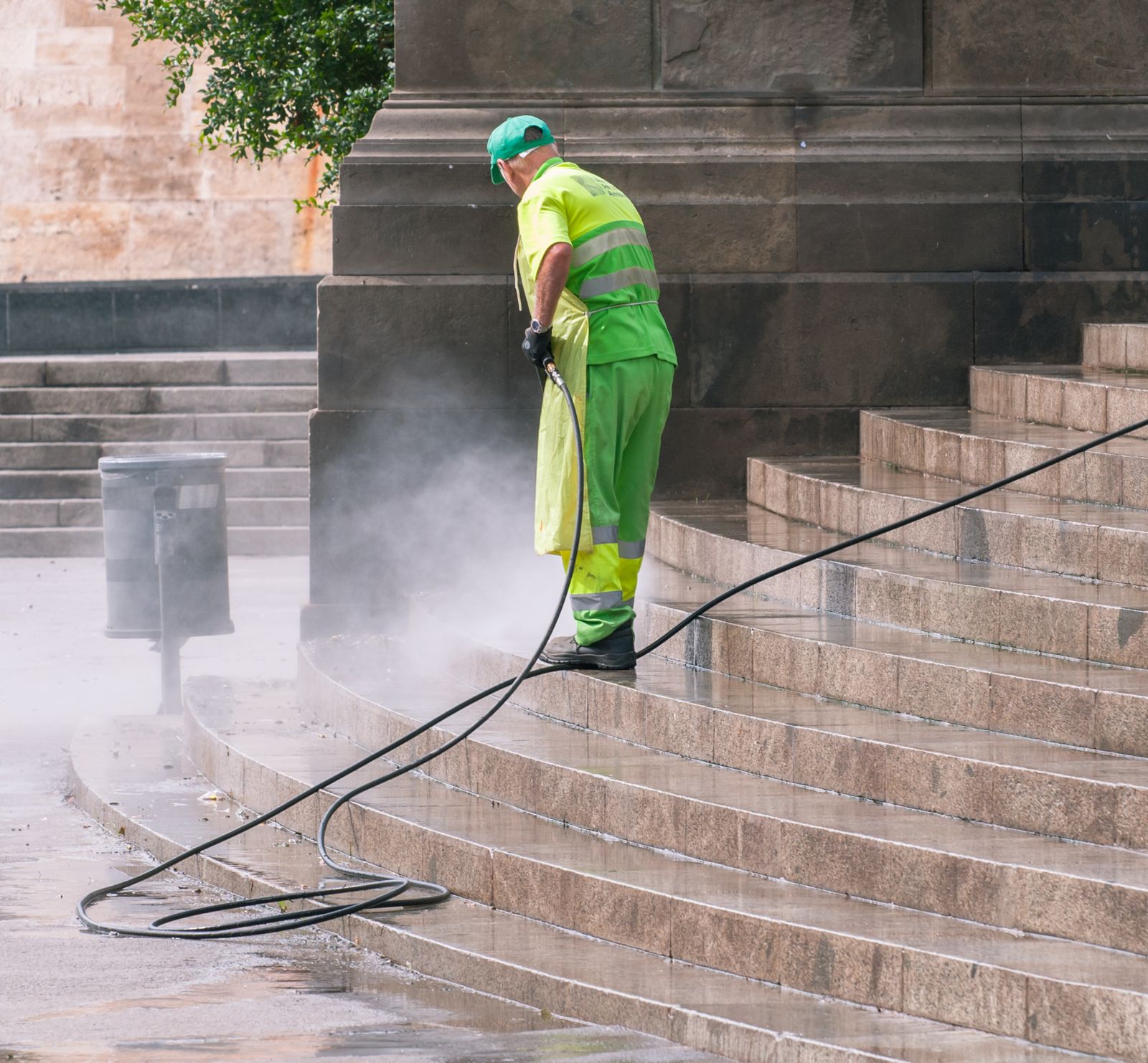
The short answer. Commercial pressure washing is priced per square foot, most commonly $0.15 to $0.50 for large surfaces like parking lots and building exteriors, with the wider market running $0.10 to $1.00 depending on surface and soil. Parking lots price lower — around $0.03 to $0.20 per square foot, or $8 to $20 per space. Specialized industrial work is often hourly at $150 to $500. And one thing most quotes never mention: on a commercial site, the wash water usually can't legally go down the storm drain.
What does pressure washing cost by surface?
| Surface | Typical rate | Notes |
|---|---|---|
| Sidewalks & concrete walkways | $0.15 – $0.35 / sq ft | The most common recurring job; fastest per square foot. |
| Parking lots & garages | $0.03 – $0.20 / sq ft | Or roughly $8 – $20 per parking space. Large area, lower rate. |
| Building exterior (soft wash) | $0.20 – $0.50 / sq ft | Low pressure for stucco, siding, painted surfaces. |
| Dumpster pads & service areas | Flat fee, commonly $150 – $500 | Grease and organic soil; needs degreaser and containment. |
| Specialized / industrial | $150 – $500 / hour | Heavy grease, height access, or equipment-intensive work. |
Commercial rates are often lower per square foot than residential because of scale — but the total invoice is higher, because you're cleaning fifty thousand square feet instead of five hundred. Don't be alarmed by a per-square-foot number that looks cheap; multiply it out before reacting either way.
The runoff rule nobody mentions
This is the part that separates a contractor from a guy with a machine, and it's worth understanding before you hire either.
The Clean Water Act prohibits discharging pollutants through a "point source" into waters of the United States without an NPDES permit — and a point source includes any discernible, confined conveyance such as a pipe, ditch, or channel. Critically, storm drains flow directly to local waterways, not to a treatment plant (EPA NPDES Stormwater Program).
Wash water carrying oil, grease, detergent, or paint residue is a pollutant. So on most commercial sites, that water needs to be contained, captured, or diverted — with berms, vacuum recovery, or routing to sanitary sewer where the local utility permits it — rather than simply allowed to sheet into the nearest drain. Municipal stormwater programs layer their own rules on top, and requirements vary by jurisdiction.
This isn't legal advice, and the specific requirements for your site depend on your municipality and what's being washed. But it's a fair question to ask before work starts rather than after.
What drives the price up?
- Soil type. Oil, grease, gum, graffiti, and mold all add labor time and chemical cost. A parking garage with oil staining is a fundamentally different job from a clean concrete walkway of the same area.
- Surface material. Brick and concrete tolerate real pressure. Stucco, painted surfaces, and older siding need soft washing — lower pressure, more chemistry, more time. Using full pressure on the wrong surface causes damage that costs more than the cleaning did.
- Height. Anything needing a lift or scaffolding changes the cost structure entirely, and adds equipment and safety requirements.
- Access and timing. Closing sections of a lot, working overnight, or coordinating around tenants all add cost.
- Water containment. Proper recovery takes equipment and time. A bid that's dramatically lower than the others has often simply skipped this.
How often should a South Florida property be washed?
More often than the national advice suggests, because humidity here grows mold and algae at a rate drier climates never deal with. A workable baseline:
- Entrances and main walkways — two to four times a year. This is the surface every visitor forms an impression on.
- Building exterior soft wash — annually, or sooner where shade and irrigation keep walls damp.
- Parking areas — annually to semi-annually, depending on traffic and oil load.
- Dumpster pads and service areas — quarterly. These generate complaints and pests faster than anything else on a property.
- Covered walkways and stairwells — twice a year; they stay damp and grow the fastest.
What you can do this week
- Measure before you call. Rough square footage of the walkways and the lot, or the number of parking spaces. Multiply against the table above and you'll know whether a quote is in the neighborhood before anyone visits.
- Walk your property looking up and down. Most managers only notice the horizontal surfaces. The north-facing wall, the covered walkway ceiling, and the stairwell are where South Florida mold shows first.
- Ask any prospective vendor how they handle wash water. One question, and it sorts commercial contractors from residential operators faster than checking references.
If you're pricing exterior work alongside interior service, our 2026 commercial cleaning cost breakdown shows how periodic work gets quoted against a recurring contract, and office cleaning contracts covers getting add-ons priced before you sign rather than after.
Want a real number for your property?
A free walkthrough measures the actual surfaces and comes back with a written, fixed price — including how we handle the water.
How we handle it
Our commercial pressure washing runs inside Purity Pro, alongside parking and exterior upkeep and gum, graffiti, and stain removal — matched to the surface, with soft washing where pressure would cause damage, and scheduled around your tenants rather than through them.
For properties already on a recurring interior program, exterior work usually folds into the same schedule and the same invoice. You can browse the full service list or see how we work across Miami-Dade and Broward, including Miami.
The bottom line
Budget $0.15–$0.50 per square foot for most commercial surfaces and $8–$20 per parking space for lots. Match the method to the material — soft wash where pressure would damage. And ask the water question, because a bid that's dramatically cheaper than the rest is frequently cheaper for a reason that ends up on your property, not the contractor's.
Quick answers
How much does commercial pressure washing cost?
Commercial pressure washing is generally priced per square foot, most commonly between $0.15 and $0.50 for large surfaces such as parking lots and building exteriors, with the wider market spanning about $0.10 to $1.00 depending on surface and soil. Parking lots often price lower, around $0.03 to $0.20 per square foot or $8 to $20 per parking space. Hourly pricing runs roughly $150 to $500 for specialized industrial work, and many jobs are quoted as flat fees from a few hundred dollars into the low thousands.
What makes a pressure washing quote go up?
Five things. Soil type — oil, grease, gum, graffiti, and mold all add labor and chemicals. Surface material — delicate finishes need low-pressure soft washing, which is slower than blasting concrete. Height — anything requiring a lift or scaffolding changes the job entirely. Access and timing — closing part of a lot or working overnight costs more. And water containment, which on many commercial sites is not optional.
Is pressure washing runoff regulated?
Yes, and it is the part most property managers do not know about. The Clean Water Act prohibits discharging pollutants through a point source into waters of the United States without an NPDES permit, and storm drains flow directly to local waterways rather than to a treatment plant. Wash water carrying oil, grease, detergents, or paint residue is a pollutant. On commercial sites that generally means the water has to be contained, captured, or diverted rather than simply allowed to run into the nearest drain, and local municipal stormwater rules add their own requirements.
How often should a commercial property be pressure washed?
In South Florida, most properties benefit from entrances and high-traffic walkways two to four times a year, full building exterior soft washing annually, parking areas annually or semi-annually, and dumpster pads and service areas quarterly. Humidity accelerates mold and algae growth here far faster than in drier climates, so a schedule that works in another state will usually be too infrequent for a Miami property.
Want this handled instead of researched?
A free walkthrough turns everything above into a written plan for your facility — usually quoted within 24 hours.
Let's make your facility spotless & compliant.
Book a free, no-obligation walkthrough. We'll assess your space, answer your questions, and build a quote tailored to your facility — usually within 24 hours.