Kitchen Hood Cleaning in Miami — Hood to Rooftop Fan, Stickered and Documented
The short answer. Kitchen hood cleaning in Miami runs on NFPA 96, which Florida’s fire code adopts (Rule 69A-3.012), and its schedule follows what you cook. Table 12.4 requires the exhaust system to be inspected for grease buildup monthly for solid-fuel cooking, quarterly for high-volume operations such as 24-hour cooking, charbroiling and wok cooking, semiannually for moderate volume and annually for low volume — churches, day camps, seasonal businesses and senior centers (NFPA 96, Table 12.4). Where that inspection finds grease, the contaminated sections must be cleaned by "a properly trained, qualified, and certified person(s)" acceptable to your local fire department. Purity’s hood crews are certified kitchen-exhaust cleaning technicians on our own payroll.
Kitchen hood cleaning — kitchen exhaust cleaning, in the code’s language — is the removal of grease from the whole path cooking vapour takes out of the building: the hood canopy and the plenum behind the filters, the grease filters, the duct that runs up to the roof, and the exhaust fan at the top. Purity Restore provides commercial kitchen hood cleaning in Miami with its own W-2 crews: a hood cleaning service for restaurants, hotel and institutional kitchens across Miami-Dade and Broward, run after close and finished with the dated label and certificate NFPA 96 calls for.
The part of the system a kitchen manager sees is the smallest part. The canopy face and the filters get attention all week; the duct and the fan are out of sight, and that is where the code looks hardest — it requires the entire system to be inspected and sets a separate grease-depth trigger for the fan housing. Restaurant hood cleaning done properly is measured at the top of the building, not at the line. The rest of the kitchen — walls, ceiling tiles, drains and floors — is on our restaurant cleaning scope, booked from the same walkthrough.
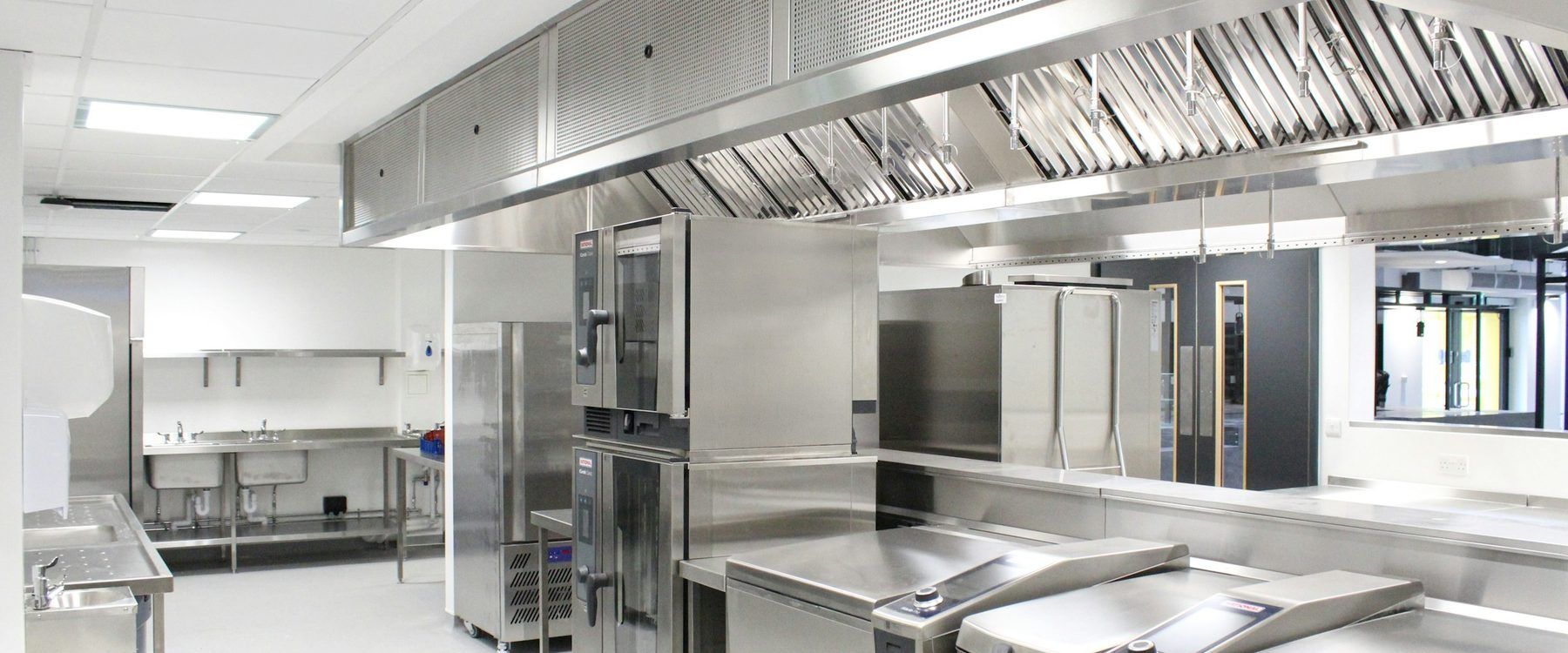
What does kitchen hood cleaning include?
Three parts of the exhaust system, and the three places the same grease ends up. One walkthrough scopes all six.
Inside and outside the canopy, the plenum behind the filters, troughs and grease cups; baffle filters degreased, damaged ones flagged for replacement. The rest of the kitchen is on our restaurant page.
Details Grease duct, hood to roofEvery accessible run from the hood collar to the fan. Not your HVAC ducts: those carry room air, run to a different standard and sit on our air duct page.
Details Rooftop exhaust fanFan opened up; bowl, blades and housing degreased. NFPA 96 gives the fan housing its own grease-depth trigger. Roof access is settled at the walkthrough.
Details Walls, ceiling & line around the hoodThe grease the hood did not catch: walls behind the line, ceiling tiles and vent faces. A deep clean booked from the same walkthrough.
Details Quarry tile & floor drainsThe floor under the line, where fryer grease settles into the grout and the drains. Heated extraction, not a mop.
Details Dumpster pad & back doorHot-water pressure washing for the grease that leaves the kitchen on its way out, with the wash water contained rather than sent to a storm drain.
DetailsWhat does Florida require for hood cleaning in Miami?
Florida does not write its own hood-cleaning rules from scratch. The Florida Fire Prevention Code adopts NFPA 96, the national standard for commercial cooking ventilation — the 2021 edition, under Rule 69A-3.012, in force since December 31, 2023. The code does not license hood cleaners through a state board or point to a single certifying body. It sets a standard of person instead, and leaves the judgment to your local fire department: the authority having jurisdiction.
"The entire exhaust system shall be inspected for grease buildup by a properly trained, qualified, and certified person(s) acceptable to the authority having jurisdiction (AHJ)."
Florida Fire Prevention Code §50.5.4, as quoted by West Manatee Fire & Rescue DistrictIn Miami-Dade, who that authority is depends on your address. Miami-Dade Fire Rescue covers unincorporated Miami-Dade, Kendall included, and 29 municipalities, among them Doral, Miami Lakes, Miami Springs, Medley and Aventura. The City of Miami, Hialeah and Coral Gables are not on that list; their kitchens are inspected by each city’s own fire department.
What "acceptable" means is a local call. One Florida district publishes its answer: West Manatee Fire & Rescue accepts companies certified through IKECA, CNHCA, CHDCA or two named training schools, and calls using an uncertified vendor "tantamount to noncompliance." We found no equivalent published list from Miami-Dade Fire Rescue or the city departments, so the practical test here is the paperwork the inspector asks to see: the certificate kept on the premises and the service label in the kitchen. A Florida fire-rescue hood checklist from St. Johns County passes or fails a kitchen on exactly that line.
What does the hood cleaning sticker mean, and what else should you get?
The sticker is the visible quarter of a four-part record. Summarising NFPA 96, the Minnesota Department of Health lists what a kitchen exhaust contractor owes you after an inspection or cleaning: a certificate naming the servicing company, the person who did the work and the date; a dated company label next to any duct access panel that was opened; and a written report that identifies areas that were inaccessible or not cleaned. The fourth piece is the service label in the kitchen with the date cleaned and the company’s name — the sticker most people mean.
The line that matters most is "not cleaned." A duct run with no access panel cannot be reached, and a sticker that says the system was cleaned when a section was not is how a kitchen ends up compliant on paper and greasy two floors up. If any part of your system could not be reached, our report says which part and why. Every Purity hood cleaning leaves the record NFPA 96 calls for, in a form you can keep in an inspection file.
About certifications. The name you will hear most is IKECA, the International Kitchen Exhaust Cleaning Association. Founded in 1989, it writes the ANSI standards for cleaning, inspecting and maintaining commercial kitchen exhaust systems — C10, I10 and M10, all listed in NFPA 96’s informational references — and certifies individual technicians (IKECA). It is one of several credentials a Florida fire authority may accept. Whoever you hire, ask to see the technician’s certificate at the walkthrough and look at the date: IKECA certifications expire on June 1 and have to be renewed, so an old card is not a current one.
What is not part of hood cleaning, and what do we need from you?
The fire-suppression system is a separate trade. The wet-chemical system over your line — nozzles, fusible links, the agent tank, the pull station — is a pre-engineered fire-extinguishing system, and in Florida servicing one is licensed work. State law defines a Class D fire equipment dealer by exactly that scope: "servicing, recharging, repairing, installing, hydrotesting, or inspecting" pre-engineered systems (§633.102, Fla. Stat.). NFPA 96 calls for that service at least every six months. We do not service it; we coordinate around it. Cleaning chemicals stay off fusible links and detection devices, the system is never left inoperable, and if something on it looks damaged we tell you so your licensed contractor can come out.
Your HVAC ducts are a different system. The grease duct runs from the hood to the exhaust fan and carries nothing but cooking vapour. Supply and return ducts carry conditioned room air and are cleaned to a different standard with different equipment — see commercial air duct cleaning.
When it is not worth booking. NFPA 96 makes cleaning conditional on what the inspection finds. If a low-volume kitchen — a parish hall, a seasonal concession — shows little grease in the duct at the walkthrough, the honest answer may be that you are not due yet, and we will say so. Likewise, if a duct run has no access panel, adding one is a modification to the duct rather than cleaning, and we will tell you which trade to call instead of quoting around it.
What we need from you. Roof access arranged with your landlord or building engineer; the kitchen closed, with the cooking equipment off and cool; your suppression contractor’s next service date; and, if you have them, the exhaust system drawings. Everything else is settled at the walkthrough, which is also where the written quote comes from.
How often does a kitchen hood need cleaning?
NFPA 96 sets how often the exhaust system is inspected; what the inspection finds sets whether it is cleaned. Here is the code’s schedule, the kitchens that fall in each tier, and the measurement that overrides the calendar.
| Kitchen type | NFPA 96 inspection | What that means |
|---|---|---|
| Solid fuel — wood, charcoal | Monthly | Wood-fired pizza ovens, charcoal grills and smokers. The strictest tier in the table. |
| High volume — 24-hour cooking, charbroiling, wok | Quarterly | The three examples NFPA 96 names. A charbroil steakhouse or a wok line belongs here even if it closes at night. |
| Moderate volume | Semiannually | Kitchens that are neither high- nor low-volume, which covers many full-service restaurants and institutional kitchens. Your fire inspector has the final word on the tier. |
| Low volume — churches, day camps, seasonal businesses, senior centers | Annually | The code’s own examples: kitchens whose hoods run a few days a month or a few months a year. |
| Any system, any tier | When the gauge says so | A grease depth of 0.078 in. (2,000 µm) on a surface, or 0.125 in. (3,175 µm) in a fan housing, means clean now, whatever the calendar says. |
| Fire-suppression system service | At least every 6 months | By a fire equipment dealer licensed by the State Fire Marshal, not by the hood cleaner. We schedule around it. |
Low-volume kitchens are the easiest to lose track of, because the hood runs a few times a month and nobody owns the date: a church hall that cooks for festivals, a venue’s catering kitchen between events. We put them on an annual calendar alongside the rest of the building’s work, the same way we schedule church cleaning and event venue cleaning. Hotel kitchens are scoped with the rest of the hotel back of house.
Where do you provide hood cleaning in Miami?
Across Miami-Dade and Broward. Hood cleaning for restaurants in Miami — Little Havana, Brickell, Wynwood — and in Hialeah, where we are based; the restaurant rows of Doral and Coral Gables; the shopping-centre kitchens of Kendall and Miami Lakes; and Hollywood and Fort Lauderdale in Broward on scheduled routes. If you searched hood cleaning Miami FL, Miami hood cleaners or vent hood cleaning near me from anywhere in the two counties, you are in our territory. One thing worth knowing before the inspection: in Doral, Miami Lakes and Kendall your fire inspector comes from Miami-Dade Fire Rescue; in Miami, Hialeah and Coral Gables, from the city’s own department.
What kitchen managers ask us.
How much does kitchen hood cleaning cost in Miami?
It is quoted on the exhaust system, not on the size of the kitchen. The number of hoods and their length, how far the duct runs to the roof and how many turns it takes, whether every run has access panels, what kind of fan sits on the roof and how hard the roof is to reach, and how long it has been since the last cleaning all move the price more than the size of the dining room does. Two kitchens with identical cook lines can be very different jobs above the ceiling. That is why we quote in writing after a walkthrough rather than publish a per-hood price we could not stand behind. Every visit carries our four-hour minimum.
How long does a kitchen hood stay clean after a cleaning?
There is no fixed number, and the code does not pretend there is. NFPA 96 sets how often the exhaust system has to be inspected — monthly for solid fuel, quarterly for high-volume cooking, semiannually for moderate volume, annually for low volume — and the inspection decides whether it needs cleaning. The trigger is measured with a depth-gauge comb: 0.078 inch of grease on a surface, or 0.125 inch inside the fan housing, means the system is due regardless of the calendar. A charbroil line gets there faster than a kitchen that mostly steams and bakes. Your staff wiping down the hood between visits is expected; it does not reach the duct or the fan.
What does the sticker on the hood mean?
It is the service label left in the kitchen after an exhaust cleaning, showing the date the system was cleaned and the company that did it. Under NFPA 96 it travels with three other records: a certificate kept on the premises naming the company, the technician and the date; a dated company label next to any duct access panel that was opened; and a written report of any area that was inaccessible or not cleaned. A fire inspector reads the sticker first. If yours is past the interval for your type of cooking, or names a company that cannot show you a certificate, that is the conversation to have before the inspector arrives.
Are your hood cleaners certified, and are they your own employees?
Yes to both. Our hood crews are certified kitchen-exhaust cleaning technicians, and they are Purity employees on W-2 payroll, not a subcontractor sent in under our name. They pass Level 2 background checks like every Purity crew, and Purity is licensed, bonded and insured, with a certificate of insurance on request. Florida’s fire code requires hood inspection and cleaning by a certified person acceptable to your local fire department, so ask any vendor, us included, to show the technician’s certificate at the walkthrough and check that it is current.
Do you service the fire-suppression system too?
No, and nobody cleaning your hood should. In Florida the wet-chemical suppression system over the line is a pre-engineered system serviced by a fire equipment dealer licensed by the State Fire Marshal, and NFPA 96 calls for that service at least every six months. We coordinate around it: we plan the cleaning with your suppression contractor’s visit in mind, keep cleaning chemicals off fusible links and detection devices, and never leave the system inoperable. If something on it looks damaged, we tell you so your licensed contractor can come out.
Is grease duct cleaning the same as air duct cleaning?
No. The grease duct carries cooking vapour from the hood straight to the exhaust fan, and it is cleaned under NFPA 96 because the grease inside it is fuel. Your HVAC ducts carry conditioned room air and are cleaned to a different standard with different equipment. A restaurant usually has both. They are separate jobs on separate schedules, and a quote that folds them together as one line of duct cleaning deserves a second look.
Does hood cleaning matter for insurance and fire inspections?
For the fire inspection, directly: the inspector reads the service label and can ask for the certificate and cleaning records. For insurance, it depends on your policy, and we will not guess at what yours says. What we can tell you is that carriers who write restaurants publish NFPA 96 guidance for their policyholders — AmTrust’s commercial cooking info sheet, written with UL Solutions, walks through the same inspection schedule and the six-month suppression service. Keep every certificate and report in one file, because that file is the only proof the work was done.
Can the hood be cleaned without closing the restaurant?
It is cleaned while the kitchen is closed, not while it cooks. The cooking equipment has to be off and cool, switches that could be turned on by accident are locked out, and equipment under the hood is covered before anything is degreased. For most restaurants that means after the last service or on a closed day, and we schedule after hours around your opening times.
Which areas do you cover? Is there vent hood cleaning near me?
Miami-Dade and Broward. Restaurant hood cleaning in Miami, Hialeah, Doral, Coral Gables, Kendall and Miami Lakes is the core, with Hollywood and Fort Lauderdale in Broward on scheduled routes. If you searched vent hood cleaning near me or hood cleaning Miami FL from anywhere in the two counties, you are in our territory. Purity is family-owned, woman-owned and based in Hialeah, and our crews work in English and Spanish.
Let's make your facility spotless & compliant.
Book a free, no-obligation walkthrough. We'll assess your space, answer your questions, and build a quote tailored to your facility — usually within 24 hours.