How to Polish Concrete Floors and Clean Polished Concrete
Polished concrete looks indestructible, and that's the trap. Here's how the polishing is actually done, what it costs, and the cleaning routine that keeps a warehouse, showroom or retail floor bright instead of slowly dulling it.
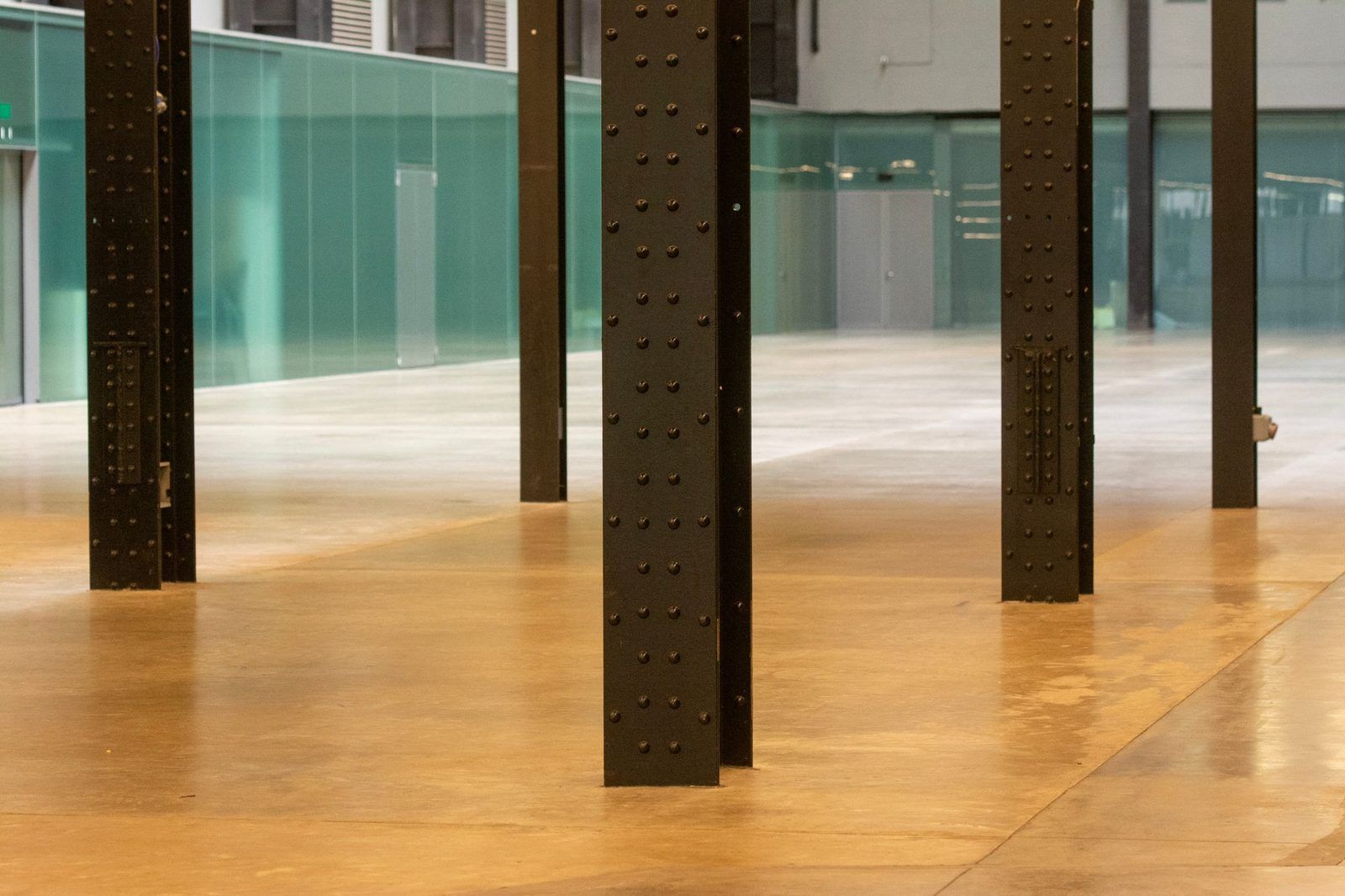
The short answer. To polish a concrete floor, the slab is ground with progressively finer bonded diamond abrasives until it reaches a set gloss. The Concrete Polishing Association of America (CPAA) defines four levels, from flat (below 100 grit) to highly polished (800 grit and higher), with a suggested minimum of 4 to 7 abrasive passes (CPAA). Done professionally it runs $3 to $12 per square foot for basic finishes (HomeGuide, February 2026). Keeping it polished is simpler: daily dust mopping, a neutral-pH cleaner, periodic burnishing, and never wax.
How do you polish concrete floors?
You polish concrete floors by cutting and refining the slab itself, not by putting anything on it. The CPAA's definition is "the act of changing a concrete floor surface" until a specified gloss is reached, and the sequence on a commercial floor runs roughly like this:
- Assess and repair the slab. Cracks, spalls and old coatings or adhesives are dealt with first; HomeGuide notes damaged slabs, leveling and coating removal all add cost.
- Grind with coarse diamonds to flatten the surface and expose the level of aggregate you chose.
- Densify. Most systems apply a densifier, a chemical hardener, to the opened surface partway through the sequence.
- Hone and polish through progressively finer diamond grits until the floor reaches the target level in the table below.
- Guard and burnish. A penetrating guard adds stain resistance, and a burnish brings up the final sheen.
The CPAA also classifies how much stone shows: from cream (very little cut) to salt and pepper (about 1/16 inch), medium aggregate (1/8 inch) and large aggregate (1/4 inch). Then the gloss:
| CPAA level | Appearance | Suggested grit | Min. passes |
|---|---|---|---|
| 1 · Flat (ground) | Flat, with no to very slight diffused reflection | Below 100 | 4 |
| 2 · Satin (honed) | Matte, with or without slight diffused reflection | 100 to 400 | 5 |
| 3 · Semi-polished | Reflections identifiable, not quite sharp | 800 and higher | 6 |
| 4 · Highly polished | Sharp, crisp, mirror-like reflection | 800 and higher | 7 |
For a facility, the level is a maintenance decision as much as a look. A level 3 or 4 floor reads as a showroom and shows every scuff and water spot; a level 2 satin floor hides daily traffic far better in a warehouse aisle or a back-of-house corridor.
Which lasts longer: diamond-polished or burnished concrete?
Diamond-polished concrete lasts longer, and the CPAA says so in its own definitions. It separates bonded abrasive polishing (grinding, honing and polishing with diamonds), burnished polishing (friction-rubbing at high speed, with or without waxes or resins), and a hybrid of the two. On the first:
That distinction is worth knowing when you inherit a floor. If a "polished" slab is really a burnished resin or wax, it needs a different maintenance plan, and most of the advice below assumes the shine is in the concrete.
Can you polish concrete floors yourself?
On a commercial floor, realistically no. Polishing takes walk-behind grinders, a full set of diamond tooling, densifier, and serious dust control. OSHA explains that respirable crystalline silica is created when cutting, sawing, grinding and drilling concrete, and estimates about 2.3 million people in the U.S. are exposed to silica at work (OSHA). That is not a weekend project in an occupied warehouse or store. The part a facility can and should own is the daily care, which is where most polished floors are actually won or lost.
How much does it cost to polish concrete floors?
HomeGuide puts polished concrete at $3 to $12 per square foot for basic finishes and $5 to $15+ for decorative work. By exposure, a cream finish runs $3 to $8, salt and pepper $4 to $10, and full aggregate $6 to $12. Size matters most: areas over 5,000 square feet can drop to $3 to $6, while spaces under 1,000 often run $8 to $15 or more. That is why polished concrete maintenance pays for itself: a floor kept on a neutral cleaner and a burnishing cycle defers the next grind for years.
How do you clean polished concrete floors?
You clean polished concrete floors with a daily dust mop and a neutral-pH cleaner, and that covers most of it. Concrete Network sums up the industry rule: "a cleaner that is too acidic or too alkaline will deteriorate the concrete and dull the shine of the floor", and recommends an automatic scrubber with a non-abrasive pad on large areas. This is the routine we start from and tune to traffic:
| Task | Frequency | What it does |
|---|---|---|
| Dust mop / microfiber | Daily | Removes the grit that does the actual abrading |
| Damp mop or auto-scrub, neutral pH | Weekly; daily in retail | Lifts soil before it is ground in; clean water is half the job |
| High-speed burnish | Monthly to quarterly | Brings gloss back without adding a coating |
| Guard / densifier touch-up | When the traffic lanes measure worn | Restores stain resistance where it has worn |
| Spill response (oil, citrus, wine, acid) | Same day | A porous surface stains or etches if it waits |
The most overlooked variable is the water. A mop bucket that goes grey halfway through the night isn't cleaning; it's spreading a thin film of soil that builds into a haze people mistake for wear.
Why has my polished concrete gone dull?
Almost always one of four causes, in the order we usually find them: the wrong cleaner, acidic, citrus-based or strongly alkaline, etching the surface microscopically; dirty water; grit abrasion at entrances and traffic lanes; or a coating someone applied in good faith to "restore the shine." HomeGuide also notes polished concrete is not completely stain proof and can be damaged by chemical or acid spills. Three of those four causes are reversible without re-grinding: fix the routine, remove any coating, and burnish. Only when burnishing no longer brings the gloss back does the floor need the diamond sequence again.
What you can do this week
- Read the label on the cleaner in use. If it doesn't say neutral pH, or it says citrus, vinegar or descaler, change it before anything else.
- Run the corner test. Compare a protected corner, behind a door or under a rack, with the busiest aisle. The corner is what the floor looked like new; the gap tells you how much a burnish can recover.
- Look in the mop bucket at the end of the shift. Grey water means the floor is being mopped with soil.
- Check the entrance matting. Most abrasion arrives on shoes and wheels; good matting does more than any product sold to protect the floor.
If the same building has coated vinyl, the rules are different; see strip and wax vs. buff and burnish. For stone, read how to get stains out of marble. And for where floor care sits in a full budget, our 2026 commercial cleaning cost breakdown puts it in context.
Has your polished floor lost its shine?
A free walkthrough tells you which of the four causes you have and comes back with a written plan and price.
How we maintain polished concrete
Our polished concrete maintenance runs inside Purity Luster: neutral-pH chemistry, the right pads, scheduled burnishing set by traffic, and guard touch-ups where the lanes measure worn. Where burnishing no longer brings the gloss back, re-polishing through the diamond sequence is quoted separately. In mixed-floor buildings it runs on the same calendar as our office floor care, and it fits the floors we see in warehouses, dealership showrooms and retail stores.
We are family-owned and woman-owned, with bilingual W-2 crews who pass Level 2 background checks, licensed, bonded and insured, and we quote in writing after a walkthrough. We work across Doral, Hialeah and Miramar, where polished slabs are everywhere in showrooms, warehouses and stores. Browse the full service list or see how we work across Miami-Dade and Broward.
The bottom line
Polishing concrete is a diamond sequence, CPAA levels 1 through 4, at $3 to $12 per square foot for basic work, and it is a job for equipment and dust control. Keeping it polished is a routine anyone can run: dust mop daily, clean with neutral pH and clean water, burnish on a cycle, and never wax. Most dull floors come back without a grinder.
Quick answers
How do you polish concrete floors?
By grinding the slab with progressively finer bonded diamond abrasives until it reaches a target gloss, usually with a densifier applied partway through and a guard at the end. The Concrete Polishing Association of America classifies four finished-gloss levels, from flat (below 100 grit) through satin (100 to 400) to semi-polished and highly polished (800 grit and higher), with a suggested minimum of four to seven abrasive passes.
How do you clean polished concrete floors?
Dust mop daily with a microfiber pad to remove grit, then damp mop or auto-scrub with a neutral-pH cleaner and clean water. Use a non-abrasive pad on an automatic scrubber for large areas. Avoid vinegar, citrus cleaners, strong degreasers and anything acidic or strongly alkaline, which etch the surface and dull the shine. Never wax it.
How much does it cost to polish concrete floors?
HomeGuide puts polished concrete at $3 to $12 per square foot for basic finishes and $5 to $15 or more for decorative work (February 2026). Large areas over 5,000 square feet can drop to $3 to $6 per square foot, while spaces under 1,000 square feet often run $8 to $15 or more. Maintaining an existing polished floor costs a fraction of re-polishing it.
Can you polish concrete floors yourself?
Small residential areas, sometimes, with rented equipment. Commercial floors are a different job: walk-behind grinders, a full diamond sequence, densifier and dust control. OSHA notes that respirable crystalline silica is created when grinding, cutting or drilling concrete, so dust capture and protection are not optional. For a warehouse, showroom or retail floor, the realistic DIY part is the daily maintenance, not the polishing.
Should polished concrete be waxed or sealed?
Not waxed. The shine on mechanically polished concrete is the slab itself, and wax traps soil, clouds the finish and later has to be stripped with chemicals the floor should never meet. A penetrating guard or sealer is a different thing: it adds stain resistance without coating the surface, and it gets reapplied at the traffic lanes as it wears.
Why does my polished concrete look dull?
Usually one of four causes: an acidic or strongly alkaline cleaner that has etched the surface, dirty mop water leaving a grey film, grit wearing the traffic lanes, or a wax or coating someone applied to add shine. Three of the four are reversible without re-grinding, by correcting the cleaning routine, removing any coating and burnishing.
Want this handled instead of researched?
A free walkthrough turns everything above into a written plan for your facility — usually quoted within 24 hours.
Let's make your facility spotless & compliant.
Book a free, no-obligation walkthrough. We'll assess your space, answer your questions, and build a quote tailored to your facility — usually within 24 hours.